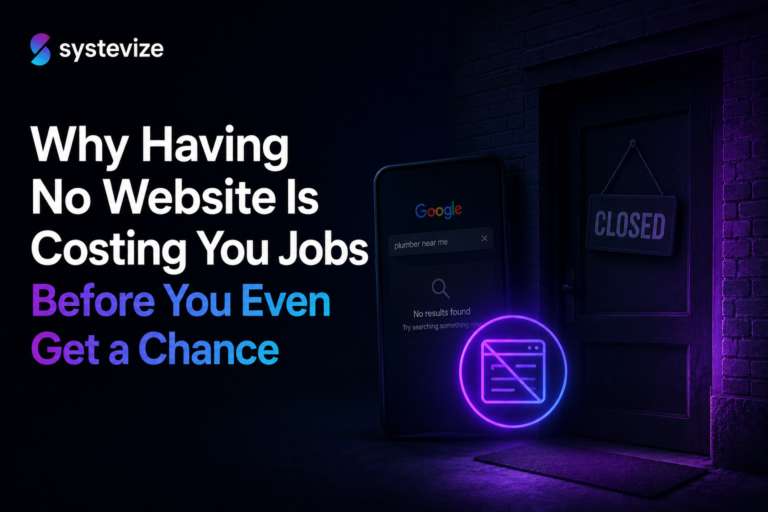
Not having a website in 2026 is one of the most expensive decisions a service business owner can make, and most of them don’t even realize they’re making it. If someone searches for your business right now and finds nothing, that job is already gone before you ever had a chance to pick up the phone.
I picked up guitar when I was about sixteen and I remember thinking I could just learn songs by ear and figure it out as I went. No lessons, no structure, just vibes. And for a while that felt fine because I was making noise and it sounded like music to me. Then I played with someone who actually knew what they were doing and I realized I had been doing this whole thing in a bubble. I thought I was progressing but I had no reference point for what I was missing.
That’s a local business with no website in 2026.
You’re out here getting work, mostly from people who already know you, referrals, regulars, word of mouth. And it feels like things are moving. But you have no idea how many people Googled you, found nothing, and moved on before you ever had a chance to say a word. You’re playing in a bubble.
The First Thing Anyone Does Is Google You
It doesn’t matter how good your reputation is in person. The moment someone hears about your business, whether from a friend, a yard sign, a door hanger, anywhere, the next thing they do is Google you. Every time. That’s just how people work in 2026. They want to see what you look like before they call. They want to feel like you’re real.
If they Google you and find nothing, one of two things happens. They assume you’re out of business. Or they assume you’re too small to trust with their money. Either way they’re gone and they never even told you they were looking. According to Stanford Web Credibility Research, 75% of people judge a company’s credibility based on their website design alone. If there’s no website, there’s no credibility check to pass. You just don’t exist.
A website doesn’t have to be fancy. It doesn’t need animations or a video background or any of that. It just needs to exist, look clean, have your services listed, have a way to contact you, and load fast on a phone. That’s the baseline. Everything above that is upside.
Word of Mouth Has a Ceiling
Here’s the thing about running purely on referrals that nobody really talks about. It works until it doesn’t. You’re completely dependent on other people’s conversations to keep your pipeline full. Someone stops referring you, has a bad month themselves, moves away, your pipeline feels it immediately.
A website is working even when your referral network goes quiet. Someone finds you at 11pm on a Sunday when you’re asleep. They fill out your contact form. You wake up to a lead. That’s what a website actually does for a business, it removes the ceiling that word of mouth puts on your growth.
I’ve sat down with business owners in the DMV who have been operating for years on reputation alone and the second they got a proper site up, they started getting calls from people they had never met, people who found them on Google and just decided to reach out. It’s not magic, it’s just being findable.
The Gap Between You and Your Competitor Is Smaller Than You Think
The businesses taking your potential customers right now aren’t necessarily better than you. They’re just easier to find. They have a clean site, a contact form, and a Google Business Profile that points people somewhere real. That’s the whole advantage and it’s not a complicated one to close.
If you’re in DC, Maryland or Virginia and you’re still running your business without a website, you’re not saving money. You’re just making it easier for the competitor who does have one to take your customers. If you’re ready to fix that, we’d love to help.